Virtual Assistant vs Employee: The Real Cost for UK Business Owners
Let’s imagine this for a minute.
We’re sat having a coffee, talking about business, and you say something like:
“I know I need help, but I don’t know whether to hire an employee or work with a Virtual Assistant.”
And honestly, that’s such a normal place to be. On the surface, hiring an employee can look like the more cost-effective option, especially when you’re just comparing hourly rates. But when you start looking at the full picture, the overheads, the legal responsibilities, and the costs people don’t always think about, it becomes a very different conversation.
So this isn’t about persuading you one way or another. It’s just me, as another business owner, explaining how the costs actually stack up.
The first thing everyone notices is the hourly rate. A Virtual Assistant’s rate is higher than an employee’s hourly wage, and I think it’s important to acknowledge that rather than brush past it.
That rate reflects experience, efficiency, and trust. When you work with a VA, you’re paying for someone who can get on with the work, spot issues, find solutions, and take ownership without needing to be managed day-to-day. VAs are business owners too, and my reputation matters just as much as yours. I want your business to succeed as much as you do, because when you do well, it directly affects my business as well.
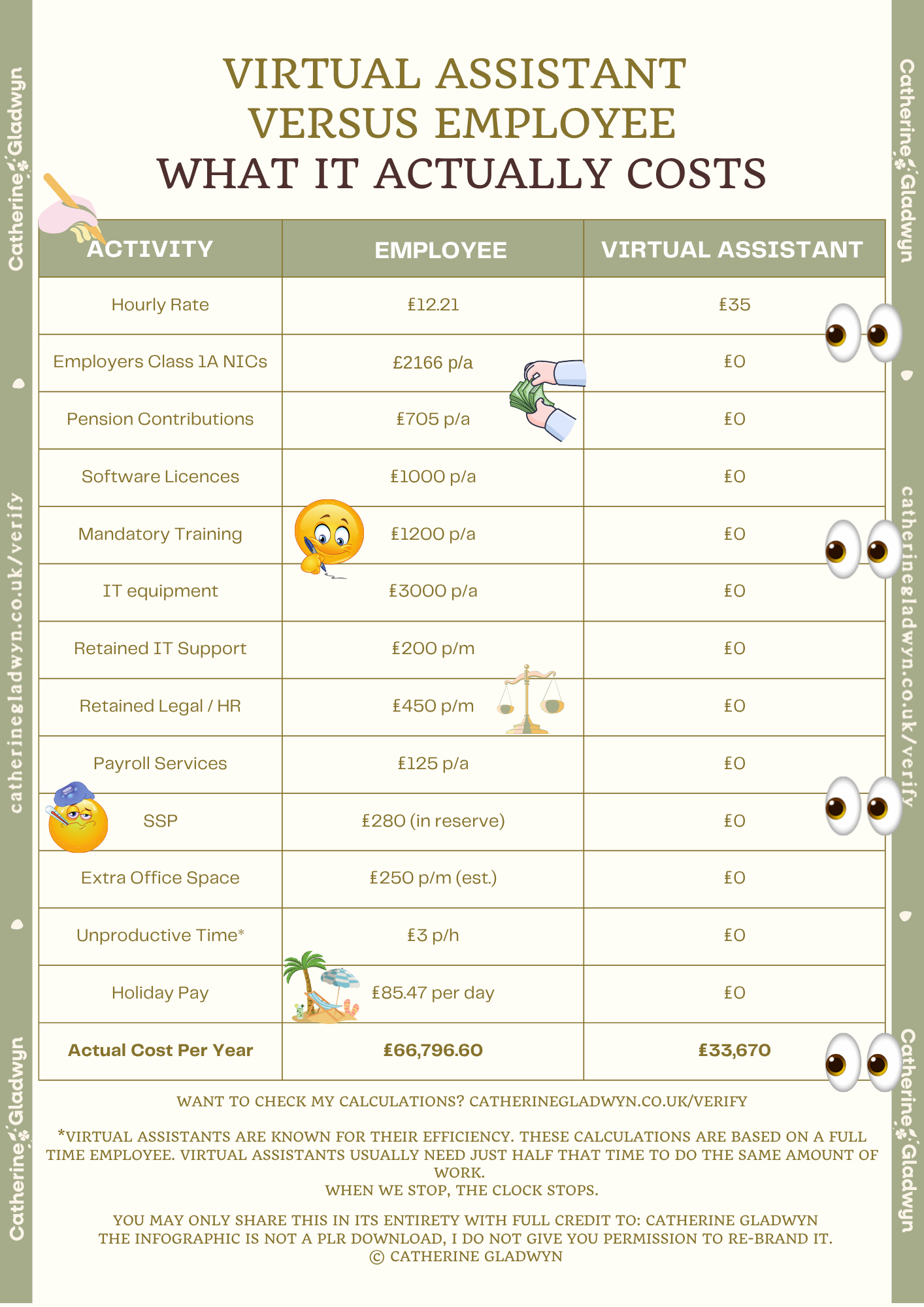
When you hire an employee, you’re also taking on employer responsibilities. Employer National Insurance Contributions and workplace pension contributions are legal requirements, and they apply regardless of the size of your business. These costs sit in the background and are easy to forget about when you’re just looking at wages. With a Virtual Assistant, those responsibilities don’t sit with you, which immediately removes both cost and administration from your side.
There’s also paid time that needs to be budgeted for when you employ someone. Employees are legally entitled to paid annual leave, and Statutory Sick Pay may apply depending on eligibility. Even when no work is being done, those costs still exist.
With a VA, there’s no holiday pay or sick pay. If I’m not working, I’m not invoicing. When I stop working, the clock stops. That gives you far more control over your costs and removes the need to hold reserves for paid time off.
Then there are the costs that creep in quietly. Software licences, training, and the time it takes to get someone up to speed. While the financial cost of training is one thing, the bigger cost is often your time, answering questions, reviewing work, and supporting someone while they learn.
Virtual Assistants invest in their own training and professional development in their own time. Keeping skills up to date is part of running a VA business, which means you benefit from that experience without paying for learning curves or lost productivity.
Hiring an employee often also means providing IT equipment, ongoing IT support, and sometimes additional office space. These are fixed overheads that stay the same whether workload is high or low. With a VA there’s no setup, no maintenance, and no IT responsibility on your side.
And then there’s HR, legal responsibilities, and payroll. Even if you outsource these services, the responsibility still sits with you as the employer, and that can feel like a lot especially for small businesses. Working with a Virtual Assistant removes that layer entirely. You’re engaging a service provider, not becoming an employer, which significantly reduces both risk and administration.
To put some real numbers against all of this, a clear cost comparison has been created by Catherine Gladwyn, comparing the cost of a full-time employee with a Virtual Assistant working 18.5 hours per week. According to her calculations, the annual cost of employing someone comes to £66,796.60, compared with £33,670 for a Virtual Assistant (scroll down to see the breakdown).
You can check and verify the full breakdown here:
https://catherinegladwyn.co.uk/verify
Full credit goes to Catherine Gladwyn.
So, Which Is the Right Choice?
This isn’t about saying one option is better than the other. It’s about understanding what works best for your business, where you are right now.
If you need someone in-house, full-time, and you’re ready to take on the responsibilities that come with employing staff, hiring an employee may be the right step.
But if you want flexible, scalable support, without fixed overheads or employer obligations, working with a Virtual Assistant can be a far more cost-effective way to grow.
And honestly, these are exactly the kinds of conversations worth having over a coffee.
If this has helped you think things through, or you want to talk about what support would actually work best for your business right now, you know where I am.
Kate x